
Overview Of Mechanical Seals
The mechanical seals is a device used to solve the sealing between the rotating shaft and the body. It is a device that prevents fluid leakage by the action of at least one pair of end faces perpendicular to the rotation axis, the elastic force (or magnetic force) of the compensation mechanism, and the cooperation of auxiliary seals to keep fit and slide relative to each other to prevent fluid leakage. Rotary fluid machinery such as compressors, reaction stirring tanks, etc., and also used for sealing of gearboxes, ship tail shafts, etc. Therefore, the mechanical seals is a universal shaft sealing device.
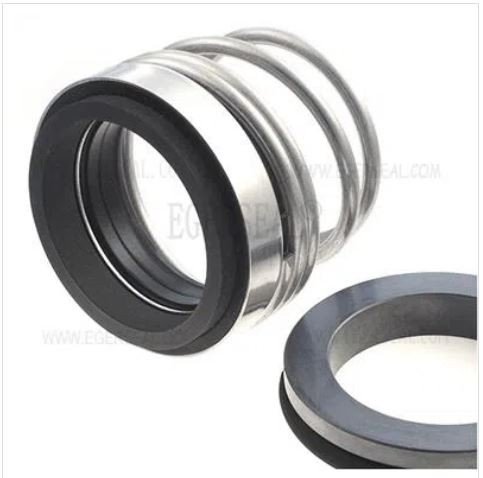
There are various mechanical seals structures, and the most commonly used mechanical seal structure is the face seal. The static ring and the moving ring of the end face seal form a pair of friction pairs, and the function of the friction pairs is to prevent the leakage of the medium. It requires the static ring and the moving ring to have good wear resistance. The moving ring can move flexibly in the axial direction and automatically compensate for the wear of the sealing surface, so that it fits well with the static ring; the static ring has a floating property and acts as a buffer. . For this reason, the sealing surface requires good processing quality to ensure that the sealing pair has good fit performance. The basic components that constitute the mechanical seals are static ring, moving ring, gland, push ring, spring, positioning ring, shaft sleeve, moving ring sealing ring, static ring sealing ring, shaft sleeve sealing ring, etc.
The elastic element (spring, bellows) mainly plays the role of preloading, compensation and buffering. It is required to always maintain sufficient elasticity to overcome the friction of auxiliary seals and transmission parts and the inertia of the moving ring, etc., to ensure a good fit of the end face seal pair. And the followability of the moving ring, the material requires corrosion resistance and fatigue resistance.
Auxiliary seals (O-rings, V-rings, U-rings, wedge-shaped rings and special-shaped rings, etc.) mainly play the role of sealing the static ring and the moving ring, and also play the role of floating and buffering. The sealing element of the static ring is required to ensure the sealing between the static ring and the gland, the static ring has a certain degree of floating, and the sealing element of the moving ring can ensure the sealing between the moving ring and the shaft or the shaft sleeve and the sealing of the moving ring. Floatability. Materials are required to be heat-resistant, etc.
Need help with seal selection?
Tell us your pump model or working conditions.